
What are the benefits of driving an electric car in Luxembourg?
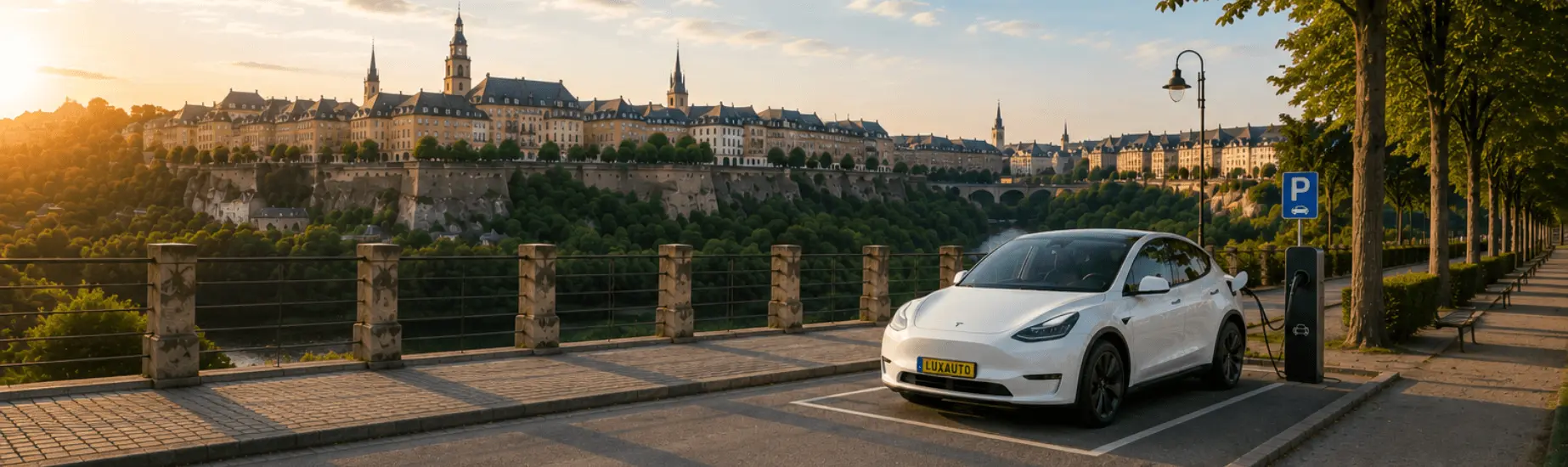
In Luxembourg, an electric car can offer real benefits if it suits your journeys and your charging options. Its main advantages are potentially lower energy costs, simpler mechanical maintenance, home charging, zero CO₂ emissions from the exhaust, and government incentives subject to certain conditions.
| Criterion | Potential benefit | Point to check |
|---|---|---|
| Cost of use | Charging at home can make the energy costs more attractive | Electricity rates, vehicle consumption and the cost of public charging |
| Maintenance | Electric motors generally require less mechanical maintenance | Tyres, brakes, suspension and other components still need servicing |
| Refill | A car can be charged whilst parked at home or at a public charging point | Access to a charging point, available power and charging price |
| Environmental impact | No CO₂ emissions from the exhaust | Manufacturing, the battery and the electricity used all count towards the life cycle |
Electric vehicles generally require less maintenance and repair than internal combustion engine vehicles, according to the Joint Research Centre of the European Commission. For public charging, the network Chargy currently reports more than 760 public charging points, including 86 SuperChargy ultra-fast charging points, in Luxembourg.
Is an electric car cheaper to run in Luxembourg?
An electric car can reduce certain running costs, but it is not automatically cheaper than a petrol or diesel car. The result depends mainly on the vehicle’s fuel consumption, the distance travelled and where it is charged.
To compare two cars properly, it is best to work out the energy cost per 100 km using your own figures:
Electric car: fuel consumption in kWh/100 km × price paid per kWh.
Internal combustion engine car: fuel consumption in litres per 100 km × price paid per litre.
Regular charging at home and keeping electricity consumption to a minimum can improve the overall picture. Conversely, frequent use of paid fast-charging points can significantly alter the outcome.
The purchase price, financing, insurance, depreciation and tyres must also be factored into the budget. To put electric vehicles in context alongside other options, the Comparison of engine types in Luxembourg helps to broaden our thinking.
Is it easier to maintain an electric car?
Yes, a 100 % electric car generally requires less mechanical maintenance relating to the powertrain than a petrol or diesel model. The electric motor has fewer moving parts, and the vehicle does not require the same maintenance as a vehicle with an internal combustion engine.
The Joint Research Centre notes a scientific consensus that battery electric vehicles require less maintenance and repair. Regenerative braking can also reduce the strain on mechanical brakes.
However, this does not mean that an electric car is «maintenance-free». Tyres, suspension, brakes, air-conditioning components and the vehicle’s systems must still be checked in accordance with the manufacturer’s recommendations.
Is it easy to charge an electric car in Luxembourg?
Charging is particularly straightforward when the driver has a charging point at home or at work. The public network then tops up daily charging and meets any occasional needs.
The Chargy network now reports more than 760 public charging points, including 86 ultra-fast SuperChargy, located in particular in public car parks, park-and-ride facilities and at locations along the road network.
The power output and price vary depending on the charging point and the supplier used. A public fast charge therefore serves a different purpose to a slow charge carried out at home over several hours.
Does a home charging point really make everyday life easier?
A home charging point allows you to make the most of your parking time to charge your car. For many drivers, this means the vehicle can recharge its battery over the course of the evening or night.
Many professionals recommend a wall-mounted charging point for reasons of convenience and safety, rather than regularly charging from a standard domestic socket.
However, it is worth checking the power available in the home and the charging settings before installation. A very high-power charging point is not necessarily essential for all uses.
Is there any financial assistance available for installing a private charging point?
A new support scheme is planned for private charging points, but its legal framework has not yet been finalised as at 13 August 2026. Guichet.lu explicitly states that the details of the 2026 scheme remain provisional until they are officially enacted. Bill 8577 is still listed as «Before the Committee» by the Chamber of Deputies.
In its current form, the scheme provides for the coverage of 50 % of the cost excluding VAT for purchase and installation. For a detached house, the advertised prices are 750 € for a standard terminal and 1 200 € for a smart charging point. A cap of 1 400 € applies to certain terminals that comply with the EN ISO 15118-20:2022 standard and for which invoices are issued on or before 31 December 2026.
These amounts must therefore be re-checked on Guichet.lu just before publication or before any investment decision is made.
Is the range of an electric car sufficient in Luxembourg?
The range of an electric car is suitable for many everyday uses, provided you choose a vehicle based on your actual journeys. Good battery life is not necessarily the maximum battery life available on the market.
Some models now offer a range of several hundred kilometres, but the actual distance travelled varies depending on driving style, the type of journey and external conditions.
Before choosing a model, it is therefore worth considering your daily journey, the proportion of motorway driving, occasional long-distance journeys and charging options. A comfortable margin also allows you to account for variations due to the weather or your driving style.
What purchase subsidies are planned in Luxembourg for 2026?
Financial support for the purchase of electric vehicles is currently undergoing a regulatory transition in Luxembourg. For a new contract signed after 30 June 2026, it is advisable to check the legal status of the new scheme before including any funding in your budget.
The diet currently described on Guichet.lu covered sales or leasing contracts entered into up to 30 June 2026. For contracts entered into on or after 1 October 2024 and meeting the specified conditions, the aid amounted to, in particular, 6 000 € for certain electric cars with a maximum energy consumption of 160 Wh/km and 3 000 € for certain other categories. Financial assistance of 1 500 € also applied to certain second-hand electric vehicles that were at least three years old.
The Government has announced its intention to extend Climate Bonus for Mobility until 30 June 2030 whilst maintaining a sliding scale of support. However, as at 13 August 2026, Bill 8725 remains the recommended course of action «In committee» by the House of Commons.
If you are making a purchase now, it is therefore advisable to check the current version on Guichet.lu before signing the contract, rather than taking the advertised amount at face value.
What is the environmental impact of an electric car?
A 100 % electric car does not produce any CO₂ in its exhaust, but its environmental impact is not limited to driving. The manufacture of the vehicle and its battery, as well as the generation of electricity, are all included in the overall assessment.
The European Environment Agency considers that a typical electric car used in Europe generates fewer greenhouse gases over its life cycle than a comparable petrol or diesel model. However, the impact of the manufacturing phase remains greater for electric cars, particularly because of the battery.
It is therefore more accurate to say zero CO₂ emissions from the exhaust rather than simply presenting an electric car as «zero-emission» or automatically «environmentally friendly».
Which drivers are best suited to electric cars?
Electric cars are particularly suitable when journeys and charging options play to their strengths. The right choice depends more on the driver’s day-to-day life than on technology alone.
It may be of interest to drivers who make regular journeys, can charge their vehicle at home or at work, and have a fairly good understanding of their travel needs. Long journeys are still possible, but require greater attention to range, charging speed and available charging points.
Conversely, a driver who does not have a convenient charging option, or who very frequently travels long distances with little time available, should carefully weigh up the alternatives.
The best vehicle is therefore not necessarily electric, hybrid, petrol or diesel as a matter of principle. It is the one that best suits the driver’s budget, journeys and actual circumstances.
How do you choose an electric car that suits your needs?
When choosing an electric car, you should start by considering how you’ll actually use it, not just the stated range. Budget, daily mileage, charging and vehicle specifications can be used to quickly narrow down the number of relevant models.
Before making a decision, be sure to compare the following in particular:
- the total budget allocated to the vehicle; ;
- the kilometres travelled each day and on the longest journeys; ;
- the advertised range and the range you actually need; ;
- power and recharge time; ;
- the option to charge at home, at work or nearby; ;
- in the case of a second-hand vehicle, the vehicle’s overall condition and the information available about its battery.
For a second-hand model, the Luxauto’s guide to buying a second-hand car in Luxembourg may carry out these checks.
The method of acquisition also matters. Drivers wishing to compare buying and leasing can consult the cars available on lease in Luxembourg.
How can Luxauto help you compare electric cars?
Luxauto allows you to narrow your search to vehicles that actually match your criteria, including engine type, make, model, budget and mileage. The aim is simple: to compare the available options before making a decision.
Are you thinking of switching to an electric car? Compare the electric cars available on Luxauto and refine your search to suit your needs. The availability of electric vehicles in the search results on Luxauto is also visible on the current platform.
FAQ
Is it possible to install a charging point in a block of flats in Luxembourg?
Yes, the 2026 scheme presented by Guichet.lu also covers the case of blocks of flats. Eligible charging points must, in particular, be smart or managed by a collective load management system. The scheme provides for a cap of €1,200 per eligible smart charging point. However, as at 13 August 2026, the legislative framework remains at the draft stage and these conditions are not yet finalised. Any installation must therefore be planned in consultation with the property manager and the installer, and based on the latest official information.
How do I pay for a top-up at a Chargy or SuperChargy charging point?
The network Chargy It accepts, amongst other things, RFID cards and badges provided by compatible operators. SuperChargy charging points also allow payment by bank card without a contract, in accordance with the terms displayed on the terminal. Some Chargy charging points offer one-off payment via a QR code. Prices depend on the provider and the service used: it is therefore advisable to check the applicable rate before starting to charge.
What should you check on the battery of a second-hand electric car?
Before buying a second-hand electric car, ask for all the available information on the condition of the battery and its history. A battery health report, where available, can help you better assess its remaining capacity. Also check the manufacturer’s warranty, if still valid, and how the car performs during a test drive. These checks complement the standard checks carried out on a used car: service history, maintenance, tyres, bodywork, equipment and documentation.
Is an electric car suitable for a cross-border worker?
An electric car may be suitable for a cross-border commuter if its range comfortably covers the daily round journey and there is a regular charging facility available at home or at work. Actual mileage, the proportion of motorway driving and winter conditions must be taken into account. For a long daily commute, charging speed also becomes a key factor. The right model therefore depends less on cross-border worker status than on the distance travelled and the charging arrangements that can be made.
Is it easy to travel abroad in an electric car from Luxembourg?
Yes, it is possible to travel internationally in an electric car, but you’ll need to check which charging points are available along the route. In particular, you need to take into account their power output, availability and the payment methods accepted. For a long journey, it is best to plan your stops based on the vehicle’s actual range rather than its certified range alone. Klima-Agence also recommends preparing your charging arrangements before setting off on a journey abroad.

Written by
Teo Fernandez
Posted on
1 October 2026