
Preparing your car for winter in Luxembourg: what you need to know
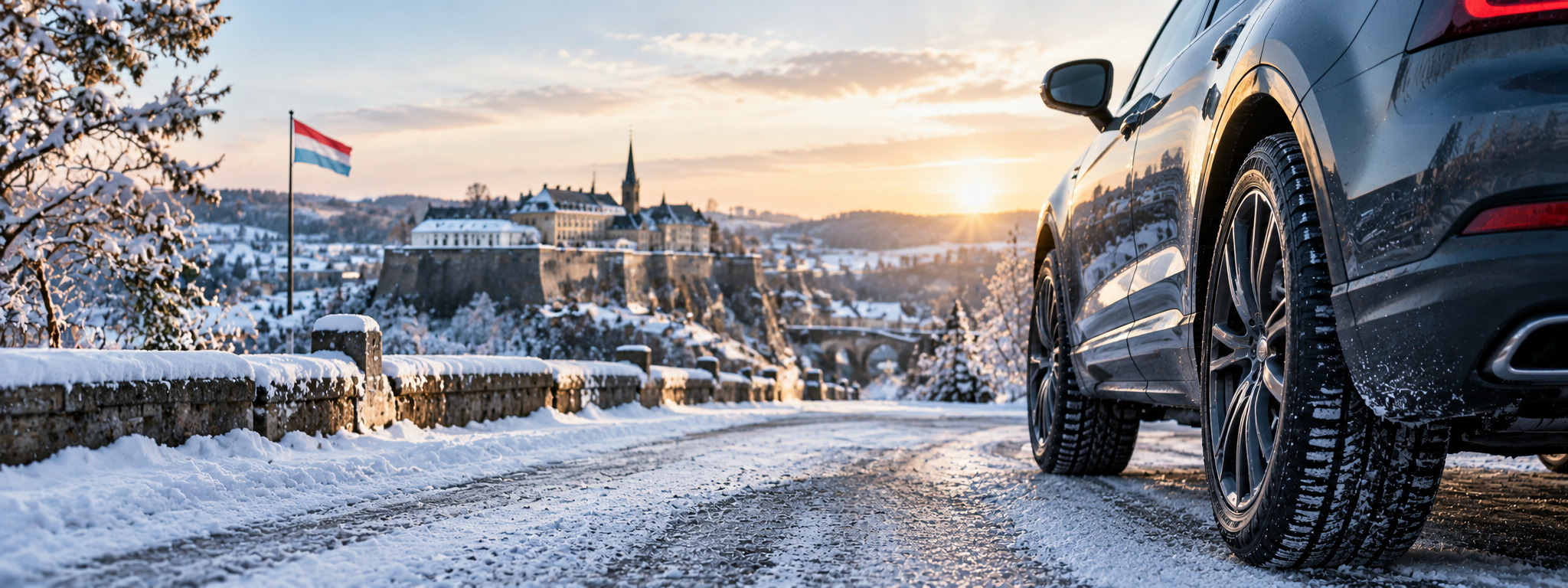
Preparing your car for winter in Luxembourg involves checking the tyres, battery, fluids, lights and visibility before the first frosts set in. The Highway Code requires winter tyres marked M+S, M.S., M&S or bearing the mountain symbol in the event of black ice, snow or frost.
Until the end of December 2026, the Grand Ducal Police will also be carrying out checks on vehicle lighting and roadworthiness throughout the country, as part of its Wanterzäit campaign.
A checklist for getting your car ready for winter
This table summarises the checks to be carried out before the first frosts.
| Element | To be checked | Why in winter? |
|---|---|---|
| Tyres | M+S, M.S., M&S or alpine symbol markings on all four tyres, tread depth, tyre pressure | A legal requirement in winter conditions; grip on cold roads |
| Battery | Start-up, age, workshop test | Cold weather reduces the amount of energy available at start-up |
| Liquids | Coolant, winter windscreen washer fluid, oil level | Prevent ice build-up and keep your windscreen clean |
| Lighting | Headlights, brake lights, indicators, fog lights | Long nights, fog, police checks |
| Visibility | Windscreen wipers, defrosting, clear windows | Unobstructed view required to the front and to the sides |
| Electric or plug-in hybrid | Pre-conditioning, refill margin | Range decreases and charging takes longer in cold weather |
| Chest | Ice scraper, gloves, blanket, torch, cables or booster | Waiting or breakdown in cold weather |
Winter tyres in Luxembourg: what the law says
In Luxembourg, the law does not specify a date: the requirement to use winter tyres depends on road conditions. As soon as there is black ice, compacted snow, slush, patches of ice or frost, a car must be fitted with compliant winter or all-season tyres. This rule applies to all drivers, regardless of the country in which their vehicle is registered. Cross-border commuters and motorists in transit are therefore also affected.
Acceptable markings and penalties
According to the Guichet.lu factsheet on winter tyres, a regulation winter tyre must bear the marking M+S, M.S. or M&S, or the Alpine symbol. This symbol depicts a mountain with three peaks and a snowflake. All four tyres must also be of the same type.
Without tyres that comply with winter conditions, the driver will be issued with a fixed penalty notice of 74 euros. The Grand Ducal Police may also impound the car on the spot, as provided for in Article 160 of the Highway Code.
Tread depth: the legal minimum
The Highway Code requires a minimum tread depth of 1.6 mm in the main grooves of each tyre. If the tread depth falls below this limit, the offence carries a fine of 145 euros and results in the loss of 2 points on your driving licence.
However, a winter tyre loses some of its effectiveness on snow well before this limit is reached: so do ask your mechanic for advice when having them fitted.
Driving in Germany, France or Belgium
The rules change as soon as you cross the border. For example, a tyre marked only M+S, without the mountain symbol, is still permitted in Luxembourg but is no longer permitted in Germany in winter conditions.
| Country | When the obligation applies | Tyres accepted |
|---|---|---|
| Luxembourg | In winter conditions, with no fixed date | M+S, M.S., M&S or the Alpine symbol |
| Germany | In winter conditions, with no fixed date | An Alpine symbol only, since 1 October 2024 |
| France | From 1 November to 31 March, in mountain communities designated by prefectural order | Alpine symbol with M+S, or snow chains in the boot |
| Belgium | No general obligation | No mandatory labelling |
Before going on a skiing holiday or driving frequently in Germany, do check that the mountain symbol is marked on the sidewall of your tyres. In France, the regulations governing mountain areas specify which markings are permitted.
Battery: the weak point on cold mornings
Cold weather reduces a battery’s capacity, whilst starting a cold engine requires more energy. A battery that is already worn out therefore often fails when the first frosts arrive. There are several warning signs to look out for: a starter motor that turns slowly, a battery warning light coming on, or electrical equipment failing.
Have the battery tested at a garage before winter, especially if it is several years old. This quick test measures its state of charge and its ability to provide the necessary starting current. An electric car also has a low-voltage battery, often 12 volts, which powers the on-board electronics: this should be checked in the same way. The ACL also explains in detail how to prevent a flat battery.
Antifreeze, windscreen washer fluid and oil: levels to check
The coolant contains antifreeze, which protects the engine and radiator from freezing. Your mechanic will check both the level and the protection temperature, as coolant that is too diluted may freeze in very cold weather.
Next, replace your summer windscreen washer fluid with a winter formula. The protection temperature is shown on the bottle: choose one based on the coldest nights you experience. Finally, check the oil level and follow the oil change interval specified in the service booklet. This booklet also specifies the correct oil for your engine, including in cold weather.
How can you ensure good visibility in winter?
Good visibility means being able to see the road and being seen by other road users. In winter, long nights, fog and frost make both of these difficult.
Spotlight: police checks to continue until the end of December
Check the headlights, sidelights, brake lights, indicators and fog lights, ideally with the help of another person. The Wanterzäit 2026 campaign The Grand Ducal Police have announced that they will be carrying out lighting checks throughout the country until the end of December. The ACL also states that the most common faults with lights and tyres.
Defrosting without leaving the engine running
Before setting off, clear the windscreen, rear window, side windows and wing mirrors completely. The Grand Ducal Police would like to remind you that driving without a clear view to the front or to the sides endangers other road users. You should also clear snow from the roof, headlights and number plates. When you first apply the brakes, snow on the roof may slide onto the windscreen.
However, the police remind motorists that it is not permitted to leave the engine running unnecessarily, for example to heat the passenger compartment or defrost the windows. Instead, use a plastic scraper and a de-icing spray. Never use hot water, as the sudden change in temperature can cause the windscreen to crack. Finally, replace your windscreen wiper blades if they leave streaks or make a noise.
Electric car or hybrid Rechargeable: winter settings
In cold weather, an electric car uses more energy to heat the passenger compartment and the battery, so its range is reduced. A cold battery also charges more slowly. However, there are a few settings that can help minimise these effects:
- Set the pre-conditioning whilst the car is plugged in: the passenger compartment and the battery will then be heated using electricity from the mains.
- On a long journey, start pre-heating the battery before a fast charge. Some models do this automatically when you select a fast-charging point in the sat-nav.
- Make sure you have a larger charging reserve than in summer, especially for cross-border journeys or night-time returns.
- It is best to use the heated seats and steering wheel, as they use less energy than heating the whole of the passenger compartment.
In very cold weather, a plug-in hybrid car may also start its internal combustion engine more frequently to heat the passenger compartment, depending on the model. The manufacturer’s manual will then set out the available settings to limit this behaviour.
The winter kit to keep in the boot
A simple kit ensures that a delay or breakdown doesn’t turn into a long wait in the cold. Keep the following in your boot:
- a scraper and a snow brush;
- gloves and a blanket;
- a torch;
- a bottle of winter windscreen washer fluid;
- jump leads or a booster;
- a mobile phone charger for the car.
If you’re heading to the mountains, make sure you fit snow chains or snow socks that are suitable for the size of your tyres.
Road salt: protecting the bodywork
The salt spread on the roads in winter accelerates corrosion of the underbody and wheel arches. So make sure you wash your car regularly during the winter, preferably at a car wash that offers an underbody wash. Before the cold weather sets in, applying a maintenance product to the door seals will also prevent them from sticking together when it freezes.
Change your car before winter with Luxauto
If your winter service reveals that costly repairs are needed, comparing quotes will help you make a decision. On Luxauto, you can filter listings by make, model, budget, mileage, location, fuel type and type of seller.
Frequently asked questions about cars in winter
When should you fit winter tyres in Luxembourg?
Luxembourg law does not specify a date for fitting winter tyres: the requirement depends solely on road conditions. In practice, it is therefore best to fit them before the first morning frosts, as black ice can appear as early as autumn. Booking an appointment with a garage early on also means you won’t have to wait until the first snowfalls. Winter tyres should then remain fitted until the risk of frost has passed in the spring.
Is it an offence in Luxembourg to park a car fitted with summer tyres?
No, a car parked with summer tyres is not breaking the law in Luxembourg. The requirement to fit winter tyres applies to driving on public roads in winter conditions, not to vehicles that are parked or stationary. A car fitted with summer tyres can therefore remain parked on the street during a snowfall. However, the driver risks a fixed penalty notice of 74 euros as soon as they drive on an icy, snow-covered or frost-covered road.
What should you prepare for a vehicle inspection in winter?
If you’re having a vehicle inspection in winter with winter tyres or rims, make sure you bring the relevant technical documentation with you. Guichet.lu warns that rims or tyres whose dimensions differ from those on the certificate of conformity may require a type-approval procedure. Technical documentation makes it easier to check that the equipment is compatible with the vehicle. Bear this in mind, particularly if your winter wheels are not the same size as the original ones.
What should you do if your battery is flat one winter’s morning?
A flat battery in cold weather can often be re-started using jumper cables or a jump-start device, following the connection sequence set out in the vehicle manual. If the car does not start, call your breakdown service, such as the ACL, your insurer or your car manufacturer. After a jump-start, have the battery tested as soon as possible, as a battery weakened by the cold is likely to fail again. For an electric car, consult the manual before attempting to jump-start it.
Are winter tyres compulsory for motorbikes in Luxembourg?
No, winter tyres are not compulsory for motorbikes in Luxembourg. The requirement does not apply to mopeds, motorcycles, tricycles, quadricycles or tractors. It does, however, apply to cars and commercial vehicles, as well as to the drive axles of heavy goods vehicles, buses and coaches. Riding a two-wheeler on an icy or snow-covered road remains very risky, however: the Grand Ducal Police recommend adapting your driving to the weather conditions.

Written by
Teo Fernandez
Posted on
5 November 2026