
What is a hybrid car? How they work and types of hybrid systems
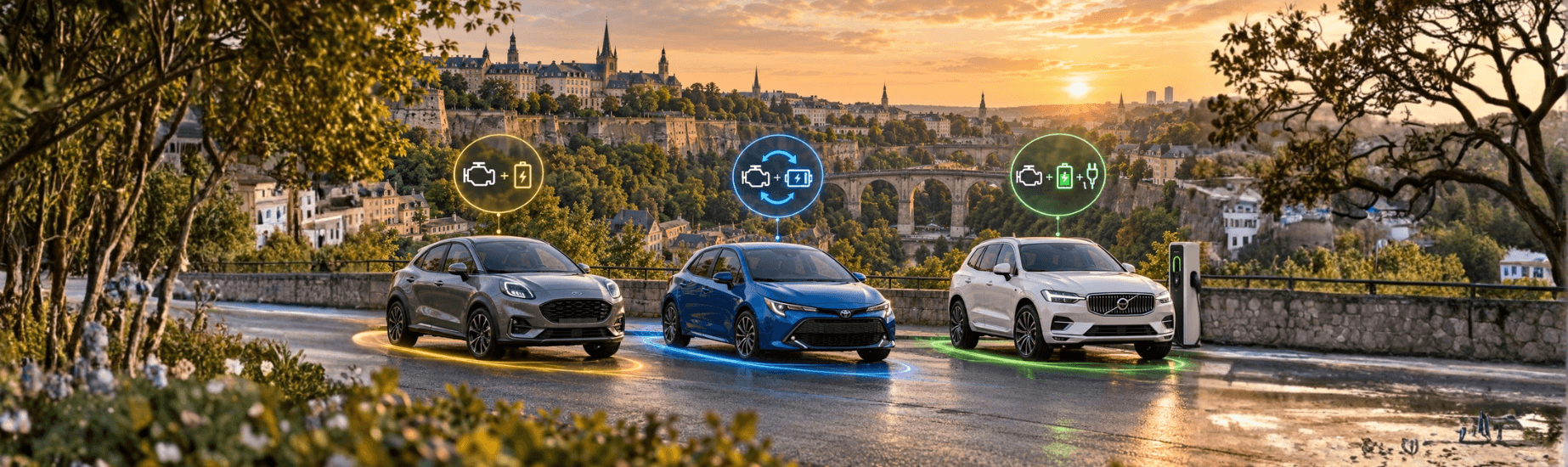
A hybrid car combines a internal combustion engine to a electric motor to provide propulsion. Depending on the level of hybridisation, the electric motor either simply assists the internal combustion engine or can power the vehicle on its own. Mild hybrid (MHEV), full hybrid (HEV) or plug-in hybrid (PHEV): the right choice depends above all on your journeys and your charging options.
Understanding these differences makes it easier to compare models and helps you avoid choosing a technology that is ill-suited to your everyday life. In Luxembourg, as in the Greater Region, the type of journey plays a particularly important role in this choice.
Two engines working together
The principle behind a hybrid car is relatively simple: it combines an internal combustion engine and an electric motor, battery-powered.
The way in which these two engines operate depends on the type of hybrid system. In some vehicles, the electric motor is used primarily for assistance. In others, it also allows the vehicle to be driven without using the internal combustion engine during certain driving phases.
In particular, the battery can recover energy during deceleration and braking. In the case of plug-in hybrid models, it can also be recharged from an external power source.
It is this difference in how they operate that is the main factor distinguishing the MHEV, HEV and PHEV.
Mild hybrid, full hybrid or plug-in hybrid: what are the differences?
Not all hybrid cars use their electric motor in the same way. Before comparing models, it is therefore worth understanding what lies behind the various terms.
| Type of hybridisation | How it works | External battery pack | Key points | Possible uses |
|---|---|---|---|---|
| Mild hybrid (MHEV) | The electric motor assists the internal combustion engine, but does not power the vehicle on its own. | No | Mild hybridisation and performance similar to that of a combustion-engine vehicle. | Drivers who want a mild hybrid system without having to recharge their vehicle. |
| Full hybrid (HEV) | The internal combustion engine and the electric motor work together. The vehicle can run on electric power alone during certain driving phases. | No | The battery is recharged, in particular, whilst driving and during energy recovery phases. | Varied journeys, particularly when driving involves regular stops and starts. |
| Plug-in hybrid (PHEV) | The vehicle combines an internal combustion engine with electric propulsion, powered by a battery that can be recharged from an external source. | Yes | Enables greater use of electric propulsion when the battery is sufficiently charged. | Drivers who can recharge regularly at home, at work or at a suitable charging point. |
The acronym MHEV means Mild Hybrid Electric Vehicle, HEV means Hybrid Electric Vehicle and PHEV means Plug-in Hybrid Electric Vehicle.
Your choice should therefore not be based solely on the word «hybrid». Two hybrid vehicles can perform very differently in everyday use.
The mild hybrid: electric assistance for the internal combustion engine
A vehicle mild hybrid (MHEV) uses an electric system to assist the internal combustion engine during certain driving phases.
The electric motor is not designed to power the vehicle on its own. Its operation therefore remains relatively similar to that of a conventional petrol or diesel car, with no need for daily recharging.
This solution may be suitable for a driver who wishes to benefit from some form of electrification without changing their charging habits.
The full hybrid: drive in electric mode without plugging the car in
A car full hybrid (HEV) can use its internal combustion engine, its electric motor or a combination of the two, depending on driving conditions.
Unlike a plug-in hybrid, the driver does not need to plug the vehicle into a charging point to use the hybrid system. In particular, the battery recovers energy during certain phases of driving.
This mode of operation may be useful for journeys involving frequent slowdowns, stops and starts.
The plug-in hybrid: electric for everyday use, with a combustion engine as a backup
A car plug-in hybrid (PHEV) has a battery that can be recharged from an external power source.
When the battery has sufficient charge, the vehicle can cover part of its journey using electric power. The internal combustion engine remains available when driving conditions or the charge level require it.
The appeal of a PHEV therefore depends heavily on the ability to charge the vehicle regularly. Before making a purchase, it is worth checking whether a charging point is available at home, at work or along your usual routes.
Which hybrid car should you choose for your journeys in Luxembourg?
The right type of hybridisation depends more on how you actually use it than on the technology itself.
For journeys that regularly involve city traffic and frequent stops, the operation of a full hybrid It may be worth comparing this with other engine variants.
If you commute to and from work and have access to a regular charging point, a plug-in hybrid is also worth considering. However, whether it is worthwhile depends entirely on your ability to use the refill regularly.
For frequent journeys on the motorway or between Luxembourg and neighbouring regions, it is important to consider the entire journey rather than focusing solely on the kilometres travelled in town. A mild hybrid, a hybrid electric vehicle (HEV) or a plug-in hybrid electric vehicle (PHEV) may suit different needs depending on how often you travel and your driving habits.
The key, then, is to start with your everyday life: Where do you ride, how often, and is it easy to recharge?
Key factors to consider before making a choice
Hybrid technology is just one factor to consider when choosing a vehicle.
Start by taking a look at your usual journeys and how often you make them. A vehicle used mainly for short journeys does not face the same constraints as a car that regularly covers long distances in the Greater Region.
When it comes to a plug-in hybrid, the charging options deserve special attention. Having regular access to a charging point can change the way you use the vehicle on a day-to-day basis.
Also bear in mind the vehicle as a whole: the budget, available space, features and specifications of the model must all meet your actual needs.
Comparing several vehicles therefore helps you find the right balance between engine type and intended use.
Compare hybrid cars on Luxauto
Once you have identified the type of hybrid system, Luxauto allows you to compare the available vehicles according to your own criteria.
Search filters allow you, amongst other things, to refine your results by make, model, budget, fuel type, gearbox or mileage. This allows you to move on from the question «Which type of hybrid is right for me?» to a selection of vehicles that actually match your search criteria.
Discover the hybrid cars available on Luxauto and compare the models that best suit your needs.
FAQ on hybrid cars
Does a hybrid car always need to be recharged?
No. A car mild hybrid (MHEV) or full hybrid (HEV) does not need to be recharged at an external charging point to operate its hybrid system. A plug-in hybrid (PHEV) On the other hand, it has a battery designed to be recharged from an external power source. The ability to recharge regularly is therefore an important factor to consider when choosing a PHEV.
What is the difference between a hybrid car and a plug-in hybrid?
A car full hybrid (HEV) uses a combustion engine and an electric motor without requiring external recharging. A plug-in hybrid (PHEV) has a battery that can be connected to a power source. This difference enables the PHEV to make greater use of electric propulsion when its battery is sufficiently charged.
Can you drive a hybrid car using only electricity?
It depends on the type of hybridisation. A mild hybrid (MHEV) uses its electrical system to provide assistance but does not rely on it to provide propulsion on its own. A full hybrid (HEV) can run on its electric motor alone during certain driving phases. A PHEV also allows you to drive in electric mode when conditions and the battery charge level permit.
Do you need a home charging point to buy a plug-in hybrid car?
A home charging point is not the only way to charge an PHEV, but regular access to a charging solution is an important factor to bear in mind. Charging may also be available at your workplace or at a suitable public charging point. Before you buy, you should therefore check how charging will fit in with your daily routine in practice.
What type of hybrid car should you choose for long journeys?
There is no single type of hybridisation that is suitable for all long journeys. When choosing between MHEV, HEV and PHEV, take into account how often you travel, the proportion of your journey on the motorway, your charging options and your other motoring needs. For drivers in the Greater Region, it is particularly useful to assess the entire home-to-work journey.

Written by
Teo Fernandez
Posted on
7 October 2026